
Made By A Fabricista: Fall is here!

Fall is here, and I have been in a coat/cape mood lately! I have a few that I plan to make, however, this pattern was not in the plans. It was in my stash, but it wasn’t on my “must make” list. I wanted to make a coordinating set but I thought it might be a little too much with this print. Now, I absolutely love animal prints, don’t get me wrong. I am a sucker for them! When I saw this jacquard double knit I had to have it. Instead, I decided to make an easy, comfortable cape that I can wear casually or dressed up. This pattern and fabric were perfect!
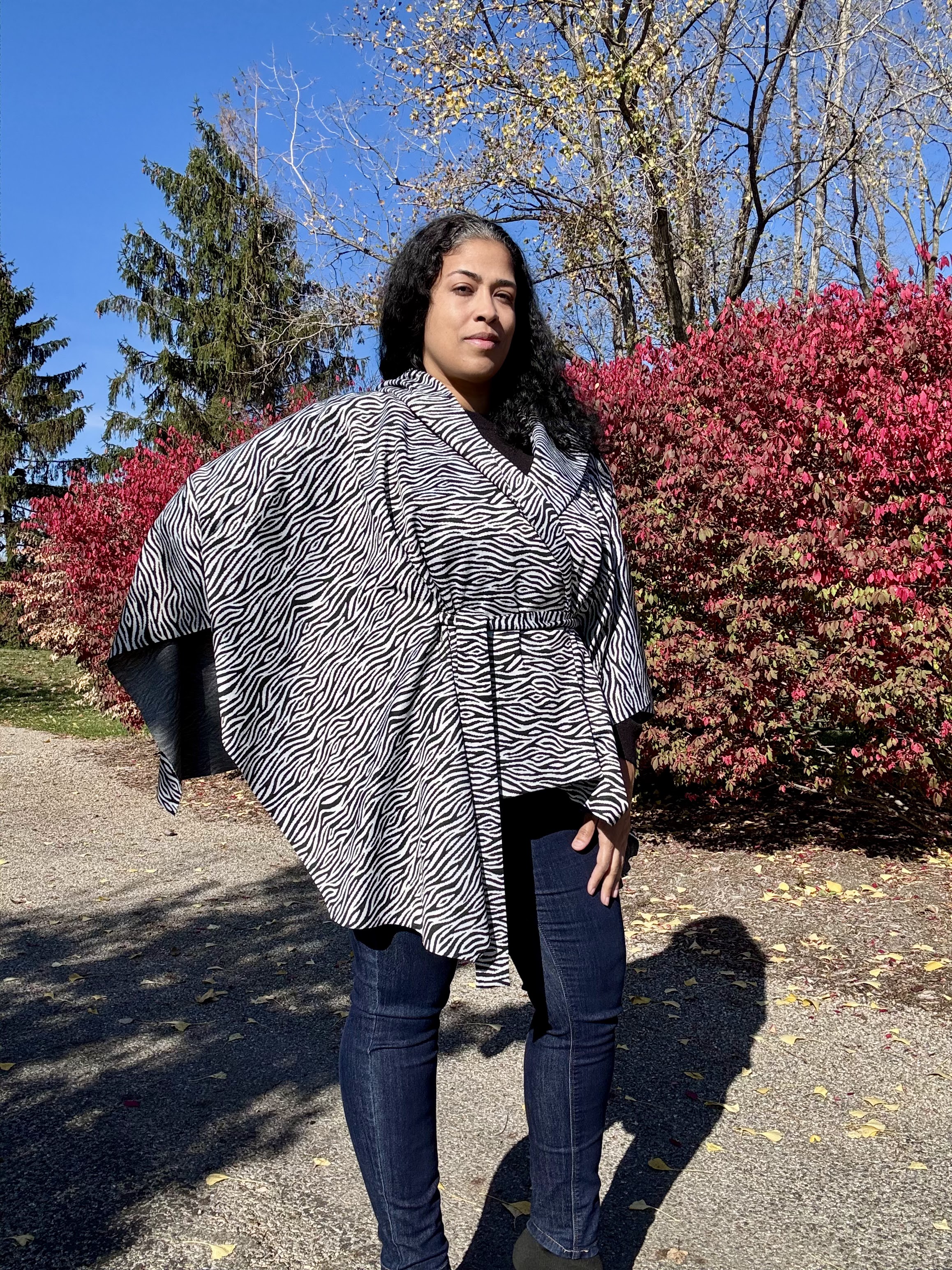
The pattern I chose to make is McCall’s 8029. This cape has three designs that you can choose from. I chose to make view C. View C has a hood. All three views have a neck and front facing and a belt/tie. Now, if you are wanting to make a cape but would like something on the easy side, this is your cape! I didn’t realize just how easy this was prior to getting started. This cape has minimal sewing. It doesn’t even require a hem. Which, was good because my serger just happened to break down on me when I started sewing. However, I do prefer a more finished look, so I turned my neck and front facings (inside edges) under and sewed a simple single fold hem to avoid exposing the interfacing. As for interfacing, the neck and front facings are the only pieces interfaced. After sewing my neck and front facings on, I chose not to edgestitch around the hood and front opening. The pattern says to pin the hood and facing to the cape wrong sides together. Instead, I sewed them on right sides together. I then stitched 5/8 inch above the front, lower edges just across to the end of each front facing and trimmed close to the stitch line. I flipped the facing to the inside and just gave the whole hood and front opening a really good press. Same as you would do for a jacket or coat with a front facing. For the remainder of each front piece, I trimmed off 5/8 inch so it would be in line with the front facings.


The pattern instructions said to fold the belt wrong sides together and just edge stitch all around the edges of the belt. Since, I was going for a more finished look, I folded right sides together and left a small opening so I could turn the belt right side out and gave it a really good press. I did turn my neck and front facing (inside edges) under and sewed a simple single fold hem so the interfacing would not be visible. 


This cape has four openings for you to slip the belt through; two in the front and two in back. The pattern instructions call the openings button holes, but says to stitch 1/18 inch around each opening and trim the inside close to the stitching, lol. Good thing, because my machine doesn’t make button holes this long and I don’t have the skill to make them by hand. If you do, then that would be a good way to get that finished look. 

If you are looking for an easy cape pattern to try, this is it! 


Until next time…

ADRIA SHANELLE  @AdriaShanelle

Comments

  1. That came out really well - bonus that it was easy, too! Great fabric choice for the pattern!

    ReplyDelete
  2. Wow! It's a great statement piece. You did a great job. Thanks for the detailed tips as well.

    ReplyDelete
    Replies
    1. Thanks and you're welcome.

      Delete

Post a Comment

Thanks for leaving a comment! All comments are reviewed before posting to help us eliminate spam. Your comment will be posted within 24 hours.

Popular Posts You Might Like

Help Our Buyers Shop!

  Comment on this post with what you are looking for right now and our buyers will seek it out!  I am craving wool gabardines and ponte knits in fun autumn colors. What about you?

Made By A Fabricista: Three Methods to Explore Colorblocking

Hey sewing friends! As I pondered what sort of plan to tackle for my next wintry project, a new and glorious array of rainbow Polartec fabrics filled the Fabric Mart site. I’ve enjoyed sewing with this brand’s fabrics for many years now, and I’m all too happy to add some more to my wardrobe.  I picked two of my favorite types, the Power Air Grid Double Knit and the Power Grid Fleece.  Choosing a few colors in matching weights to combine them into something totally me sounded perfect. Look at this stunning heap!  When I’m sewing two different fabrics together, I prefer to use the same weight and type so that they behave similarly and hang well together. Any extra piecing like this also creates topstitching opportunities galore! (You already know I’m all about that available thread matching.) In this case, I opted for three colors in each of the two fabric varieties I mentioned above for the best combining results.  I figured I’d dive in with a brief overview of how y...

Made By A Fabricista: Coat Sewing Chronicles

Sewing a coat is not for the faint of heart, or for the sewist looking for a light project. It is possibly the slowest form of apparel sewing that exists. If you’ve made a coat, chances are, you know what I mean. No matter what you do, you can’t rush through it, you can’t skip steps or cut corners, you just have to roll with the punches. One minute you’re flying through assembly thinking “I’ll be finished soon,” and the next you’re running away from your sewing room because you need space. Are you guaranteed to end up with a bespoke wonder in your coat closet, most definitely! But heed my warning, if you are looking for a quick win, it is not a coat!  My coat sewing chronicles began around Christmas when I fell in love with a black-and-white basketweave wool-coating fabric on the Fabric Mart website. I quickly placed an order for 3.75 yards to finally make the Seamwork Bay coat I’ve been dreaming of making for a while. In addition to my Fabric Mart wool, I also ordered Kasha Satin...