Made by a Fabricista: There's Navy and Then There's NAVY


I went very bright for my last make so I decided to tone it down with a neutral this month. Navy is a neutral that I lack in my wardrobe as I default to black often so I'm trying to remedy that. The first is a very soft jersey knit with uneven stripes and the second is truly a luxurious wool stretch twill. My plan was to sew a coordinating outfit, but as soon as the fabric arrived I realized that all navy blues aren't created equal. Unfortunately, the two blues were just too different to work together. This was totally my fault as the wool twill description literally states "the darkest navy". Still I love both fabrics so I sewed my original plans, it just seems that these two pieces won't be worn together. Thankfully, I recently purchased this RTW light weight sweater that is a better match to the twill.

Not the best lighting, but trust me they are different.
Let me first tell you about the wool twill suiting, as I am in love with it! Some stretch is a MUST for me in pants and this twill offers four-way stretch thanks to the 5% Lycra content (40% across, 30% lengthwise). The soft feel was the first thing I notice while unboxing and though you can tell it's wool, it's not itchy. I often think heavy and thick when I think wool, but this is the perfect suiting weight. My favorite feature is the drape, which is why I opted for wide leg slacks. Trust me and order yourself a few yards (here). It's in the 70% off category and is a STEAL. The description of "darkest navy", as mentioned above, is accurate as you almost have to hold it up to something black to see that it is in fact blue. I truly wish this was available in multiple colors as I would purchase all of them! I may have to order more for a skirt and/or blazer.


I used Simplicity 1017, which is an Amazing Fit pattern, for these wide leg slacks. Amazing Fit patterns have always worked well for me, though this is my first Amazing Fit pants attempt. They typically feature classic silhouettes which is awesome for newbie as well as experienced sewists. The detailed step-by-step instructions provide a method of construction that allows you to fit as you sew. All of the fitting seams, ie side seams in these slacks, have a built in 1" seam allowance to allow for fitting adjustments.


I do have one tip that I learned for a sewist on Instagram (I really wish I remembered who shared it) and want to share with you. When you have facings that required a finished edge sew the iron on interfacing with RSF along the edge that needs finishing, trim the seam allowance and then fuse the interfacing WSF. This results in a clean finished edge that does require moving to you serger, adding bulking bias tape or switching your stitch to a zig-zag. 


Now that I have this fit down, I see myself sewing these over and over. They may be the only slacks I wear to work! Don't you just love when you pair great fabric with the perfect pattern? I know I do. This project was definitely a perfect pairing.


Now let's talk about this simple tee I sewed using Simplicity 8177 (which contains a great tee pattern that is often overlooked). Sewing a tee is pretty simple if you're familiar with working with knits, but matching stripes on a jersey fabric can be tricky. The safest bet to keep the stripes straight is to cut out each piece on a single layer but this would mean tracing the front and back pieces to create a full piece. To avoid that (because I'm lazy) I carefully laid out my fabric and then folded over just enough to cut the front piece before pinning the selvage edge aligning the stripes. This helps to ensure the fabric doesn't slip and it prevents the selvage edge from curling up.


When placing the pattern piece I line up a particular feature of the pattern, such as a notch or a dot, and make sure it lines up with something on the fabric. Here I use the extend/shorten line on the back and line it up with the bottom of a white line. Then when I cut the front piece I set up my fabric the same way and line up the extend/shorten line up again with the bottom of the white line. This ensures my side seams will line up. 
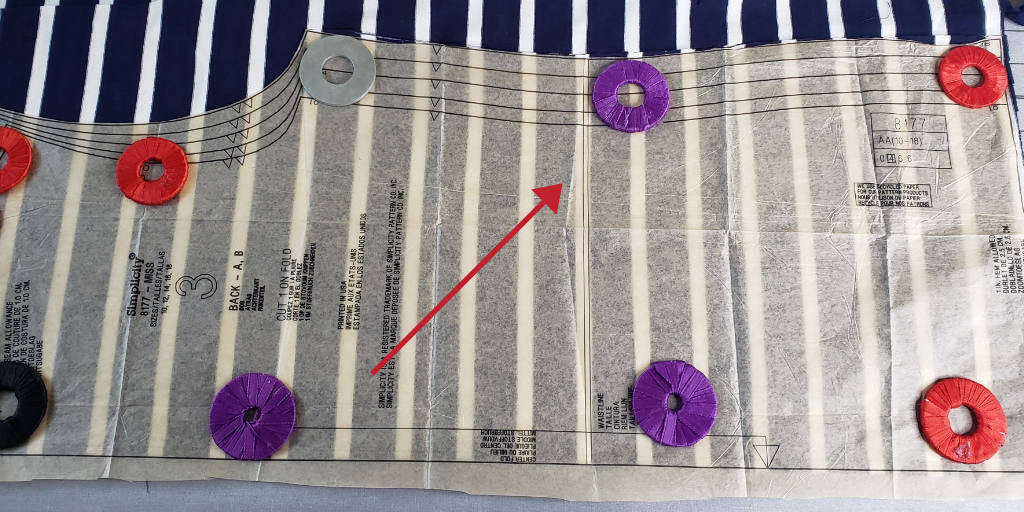

When sewing I take the same approach and pin the seams together lining up the stripes. Though this is a thinner jersey I didn't have any issues sewing it up. To be extra safe you can use a walking foot which helps your machine feed both layers under your presser foot at the same rate, so you lines stay aligned.
I don't worry so much about matching at the sleeve seam because lining up
stripes along a curve is annoying, but look at that side seam!
I love my tee and this jersey is so smooth and soft that it's a dream to wear. Sometimes these types of basic makes don't get much love, but they are usually the items that get the most wear. 


What are your favorite basics? and which fabrics do you keep on hand for those types of projects?


Comments

  1. I love this post. The pants look wonderful and I may need to try again, the fba (full bum adjustment) is a big challenge. Classic look that is a great staple in any wardrobe.

    ReplyDelete
    Replies
    1. Thank you! I too typically need a BBA (big booty adjustment is what I call it), but I didn't add anything to the back rise and surprisingly cut the average back based on my measurements. In hindsightI should've added maybe a 1/2" to the back crotch, but in this fabric which has a vertical stretch it's fine. I definitely say give these a try.

      Delete
  2. Nice job. I feel your pain on the navy that doesn't match. I've also had black that doesn't match. Seems impossible, but it can be too brown looking and not go with anything.

    ReplyDelete

Post a Comment

Thanks for leaving a comment! All comments are reviewed before posting to help us eliminate spam. Your comment will be posted within 24 hours.

Popular Posts You Might Like

Made By A Fabricista: The Sheer Volume Of It All!

This garment was inspired by a dress I saw in an ad, and when I went to purchase it (which I rarely do)…I realized that the dress didn’t come in my size. Ticked off and with $300 back in my pocket, I decided to draft it myself. The description listed the fabrication as a silk cotton voile, so I used that as a starting point to recreate the simple yet elegant silhouette.  My drafting experience is limited; I’ve only ever made garments that are pleated rectangles that fit into an elasticated waist. No darts, no complicated calculations, and definitely no sleeves. But I’d have that dress if it’s the last thing I do! I made a drawing, created a Pinterest board to document my inspiration, and narrowed down the features I really wanted to have: billowy bubble-hemmed bishop sleeves (say it three times fast!), a fitted and lined bodice, and a gathered tiered skirt. Finally, it was time to shop for fabric. I knew I wanted a silk blend of some kind, without breaking the bank. For weeks, I ke...

Made By A Fabricista: Just Wear It Out!

Originally I wasn’t happy with my make this time around. I put it on fresh off the sewing machine and didn’t love how it fit. My elastic was slightly too narrow for what the pattern called for. I did end up putting a stitch to close up the v-neck on the top. I thought my sewing on the waistband looked sloppy and I looked kind of frumpy in the outfit. I was going to put the project down to fix later but decided to wear it out for some feedback from our web manager and one of the describers.  I ended up pleasantly surprised! The fabric is super comfortable and I felt really good wearing it. All the things I didn’t like kind of melted away wearing it out. The flaws were so small that only I noticed them. I think it’s important to remember that while striving for perfect seams and flawless construction is good, a handmade garment doesn’t have to be perfect to be wearable. This isn’t the first time I’ve softened on a garment after wearing, and it certainly won’t be the last! The 100% c...

Made By A Fabricista: In Love with Linen

Linen is the best fabric to sew and wear. I selected a beautiful 100% linen from Fabric Mart that is a steel blue and cream floral linen to sew up a By Hand London Hannah Wrap Dress pattern. The flowers look like Dahlias. I originally sewed a Toile from a black and white cotton bedsheet, wore the dress a lot but never made it again. I gave the Toile away to a friend who always commented on how much she loved the dress. When I saw this fabric, I knew I wanted to make the Hannah again. Linen is so easy to sew the entire experience reminded me why linen remains one of my favorite fabrics to sew. I look for a light to medium weight  European linen for a dress. I like a rayon or cotton blend with linen because it seems to have more drape and be more soft. Linen gets softer with washing and wearing it. This particular linen feels crisp and after ironing and washing, softens up. I like how Fabric Mart describes the fabrics as top, dress, blouse, shirt weight under “Use” and will describe...